Yes Weekly: Wheelhouses and Modern Robots
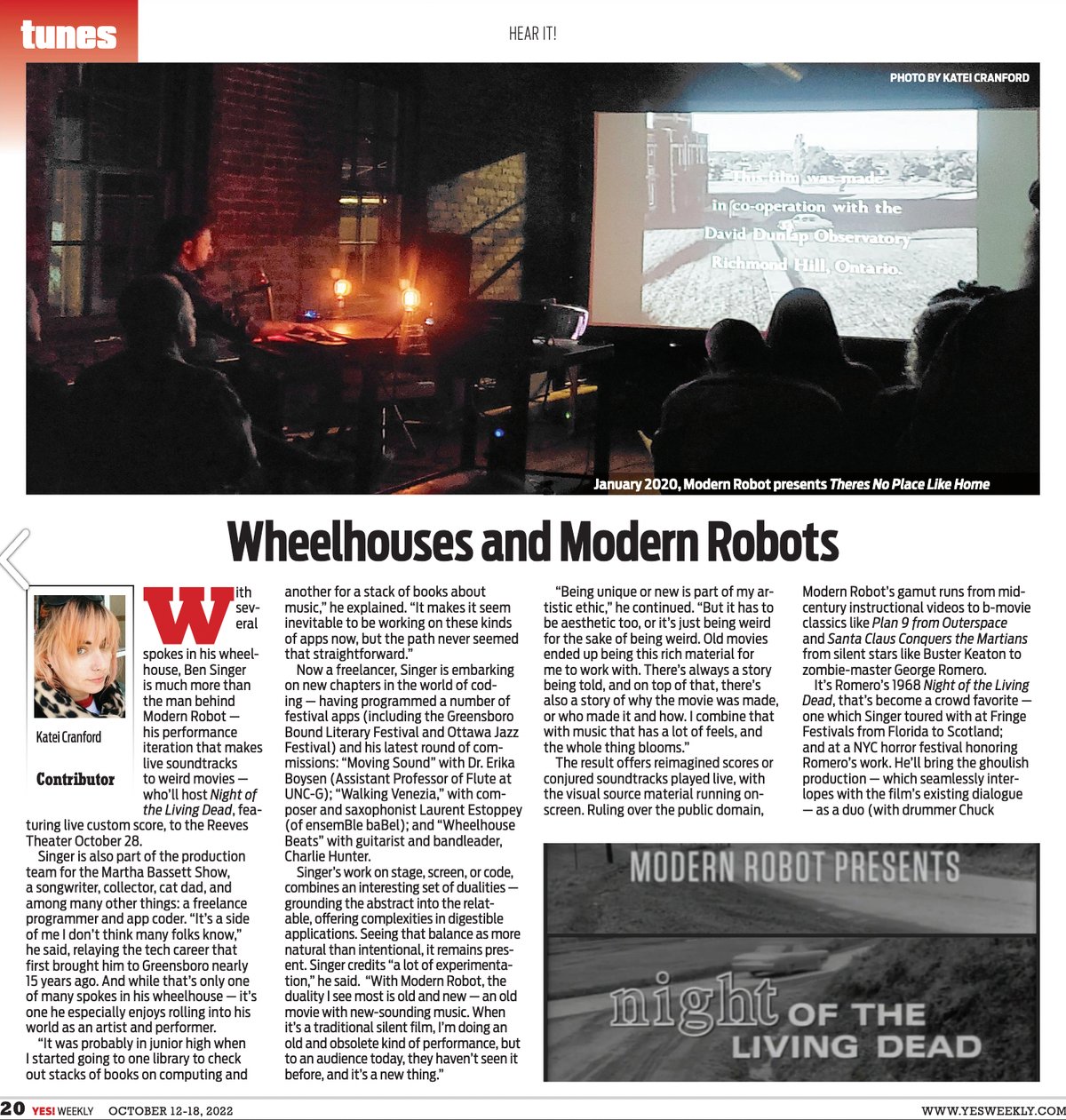
With several spokes in his wheelhouse, Ben Singer is much more than the man behind Modern Robot — his performance iteration that makes live soundtracks to weird movies — who’ll host Night of the Living Dead, featuring live custom score, to the Reeves Theater October 28.
Singer is also part of the production team for the Martha Bassett Show, a songwriter, collector, cat dad, and among many other things: a freelance programmer and app coder. “It’s a side of me I don’t think many folks know,” he said, relaying the tech career that first brought him to Greensboro nearly 15 years ago. And while that’s only one of many spokes in his wheelhouse — it’s one he especially enjoys rolling into his world as an artist and performer.
“It was probably in junior high when I started going to one library to check out stacks of books on computing and another for a stack of books about music,” he explained. “It makes it seem inevitable to be working on these kinds of apps now, but the path never seemed that straightforward.”
Now a freelancer, Singer is embarking on new chapters in the world of coding — having programmed a number of festival apps (including the Greensboro Bound Literary Festival and Ottawa Jazz Festival) and his latest round of commissions: “Moving Sound” with Dr. Erika Boysen (Assistant Professor of Flute at UNC-G); “Walking Venezia,” with composer and saxophonist Laurent Estoppey (of ensemBle baBel); and “Wheelhouse Beats” with guitarist and bandleader, Charlie Hunter.
Singer’s work on stage, screen, or code, combines an interesting set of dualities — grounding the abstract into the relatable, offering complexities in digestible applications. Seeing that balance as more natural than intentional, it remains present. Singer credits “a lot of experimentation,” he said. “With Modern Robot, the duality I see most is old and new — an old movie with new-sounding music. When it’s a traditional silent film, I’m doing an old and obsolete kind of performance, but to an audience today, they haven’t seen it before, and it’s a new thing.”
“Being unique or new is part of my artistic ethic,” he continued. “But it has to be aesthetic too, or it’s just being weird for the sake of being weird. Old movies ended up being this rich material for me to work with. There’s always a story being told, and on top of that, there’s also a story of why the movie was made, or who made it and how. I combine that with music that has a lot of feels, and the whole thing blooms.”
The result offers reimagined scores or conjured soundtracks played live, with the visual source material running on-screen. Ruling over the public domain, Modern Robot’s gamut runs from mid-century instructional videos to b-movie classics like Plan 9 from Outer Space and Santa Claus Conquers the Martians from silent stars like Buster Keaton to zombie-master George Romero.
It’s Romero’s 1968 Night of the Living Dead, that’s become a crowd favorite — one which Singer toured with at Fringe Festivals from Florida to Scotland; and at a NYC horror festival honoring Romero’s work. He’ll bring the ghoulish production — which seamlessly interlopes with the film’s existing dialogue — as a duo (with drummer Chuck Pickney) to the Reeves Theater in Elkin on October 28.
Praising Pickney’s awareness and technique, Singer remarked on the processes essential to his work within Modern Robot and the coding world — both of which require experimentation and creativity to truly resonate with audiences in ways that ground the abstract or cleanly convey complex information.
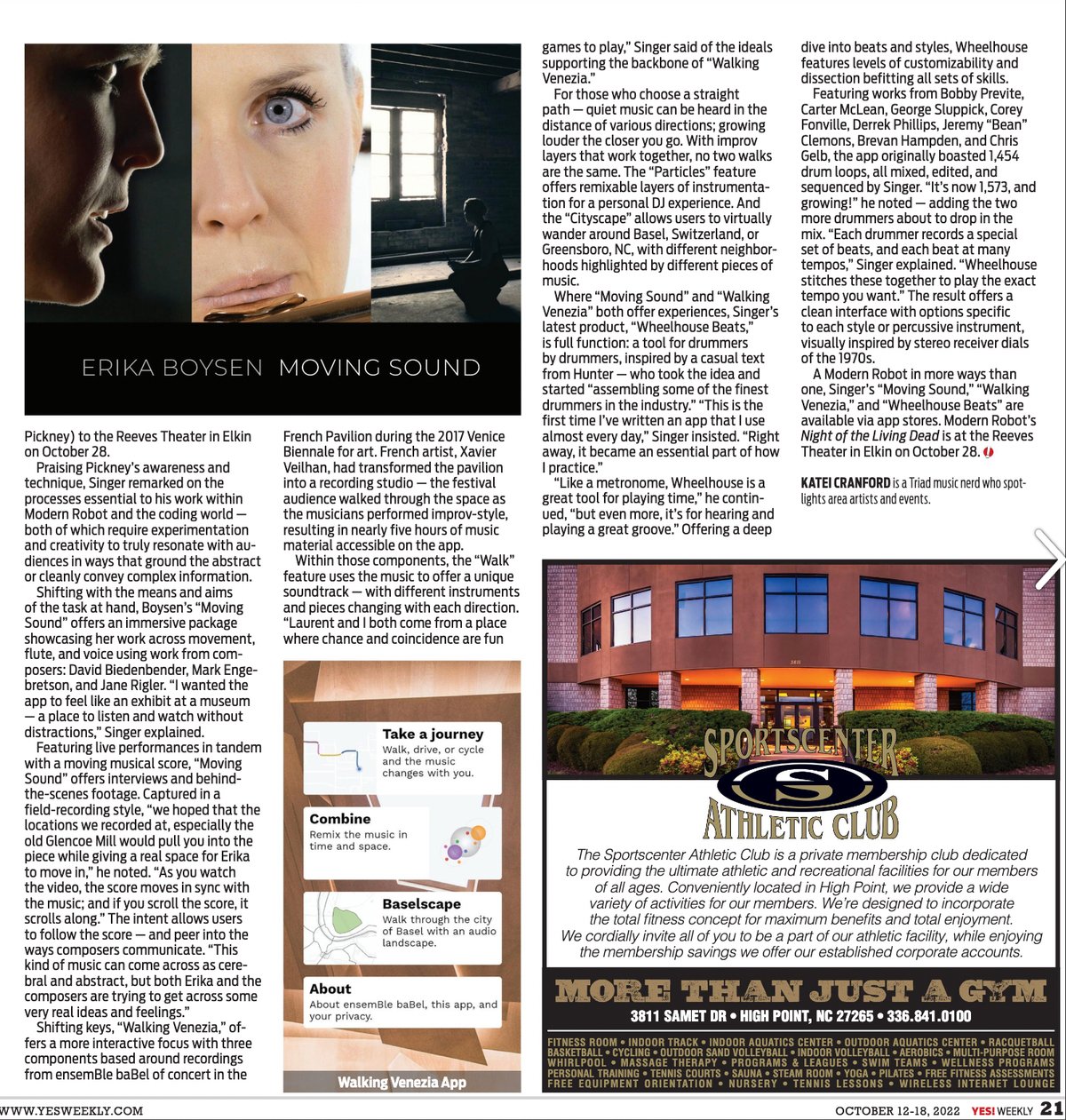
Shifting with the means and aims of the task at hand, Boysen’s “Moving Sound” offers an immersive package showcasing her work across movement, flute, and voice using work from composers: David Biedenbender, Mark Engebretson, and Jane Rigler. “I wanted the app to feel like an exhibit at a museum — a place to listen and watch without distractions,” Singer explained.
Featuring live performances in tandem with a moving musical score, “Moving Sound” offers interviews and behind-the-scenes footage. Captured in a field-recording style, “we hoped that the locations we recorded at, especially the old Glencoe Mill would pull you into the piece while giving a real space for Erika to move in,” he noted. “As you watch the video, the score moves in sync with the music; and if you scroll the score, it scrolls along.” The intent allows users to follow the score — and peer into the ways composers communicate. “This kind of music can come across as cerebral and abstract, but both Erika and the composers are trying to get across some very real ideas and feelings.”
Shifting keys, “Walking Venezia,” offers a more interactive focus with three components based around recordings from ensemBle baBel of concert in the French Pavilion during the 2017 Venice Biennale for art. French artist, Xavier Veilhan, had transformed the pavilion into a recording studio — the festival audience walked through the space as the musicians performed improv-style, resulting in nearly five hours of music material accessible on the app.
Within those components, the “Walk” feature uses the music to offer a unique soundtrack — with different instruments and pieces changing with each direction. “Laurent and I both come from a place where chance and coincidence are fun games to play,” Singer said of the ideals supporting the backbone of “Walking Venezia.”
For those who choose a straight path — quiet music can be heard in the distance of various directions; growing louder the closer you go. With improv layers that work together, no two walks are the same. The “Particles” feature offers remixable layers of instrumentation for a personal DJ experience. And the “Cityscape” allows users to virtually wander around Basel, Switzerland, or Greensboro, NC, with different neighborhoods highlighted by different pieces of music.
Where “Moving Sound” and “Walking Venezia” both offer experiences, Singer’s latest product, “Wheelhouse Beats,” is full function: a tool for drummers by drummers, inspired by a casual text from Hunter — who took the idea and started “assembling some of the finest drummers in the industry.” “This is the first time I’ve written an app that I use almost every day,” Singer insisted. “Right away, it became an essential part of how I practice.”
“Like a metronome, Wheelhouse is a great tool for playing time,” he continued, “but even more, it’s for hearing and playing a great groove.” Offering a deep dive into beats and styles, Wheelhouse features levels of customizability and dissection befitting all sets of skills.
Featuring works from Bobby Previte, Carter McLean, George Sluppick, Corey Fonville, Derrek Phillips, Jeremy “Bean” Clemons, Brevan Hampden, and Chris Gelb, the app originally boasted 1,454 drum loops, all mixed, edited, and sequenced by Singer. “It’s now 1,573, and growing!” he noted — adding the two more drummers about to drop in the mix. “Each drummer records a special set of beats, and each beat at many tempos,” Singer explained. “Wheelhouse stitches these together to play the exact tempo you want.” The result offers a clean interface with options specific to each style or percussive instrument, visually inspired by stereo receiver dials of the 1970s.
A Modern Robot in more ways than one, Singer’s “Moving Sound,” “Walking Venezia,” and “Wheelhouse Beats” are available via app stores.
Modern Robot’s Night of the Living Dead is at the Reeves Theater in Elkin on October 28.
Katei Cranford is a Triad music nerd who spotlights area artists and events.